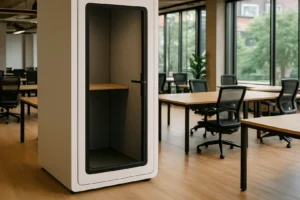
Why Open-Plan Offices Need an Acoustic Phone Booth
Table of Contents
Open-plan offices are designed to encourage collaboration, but the side effect is immediate the moment one employee takes a call: everyone in the room hears the conversation, and the person on the phone has to raise their voice to compete with background noise. That cycle repeats all day.
Research on open-plan work environments consistently ranks noise distraction, not temperature or lighting, as the leading cause of productivity loss. Important client calls, remote meetings with colleagues in other cities, or internal strategy discussions that should stay confidential all happen in the middle of keyboard noise, neighbouring desk conversations, and email alerts going off in rotation.
This is not purely a comfort issue. When sensitive business conversations, contract negotiations, financial reports, or HR consultations can be heard by anyone walking past, the company faces a real data-confidentiality risk. In sectors such as healthcare, banking, or law, that kind of information leak is not just embarrassing. It can carry regulatory consequences.
The conventional fix is to build additional meeting rooms or dedicated phone rooms. But renovation requires building permits, months of construction time, and significant cost, and the result is permanently attached to the building even after business needs have changed.
A modular soundproof telephone booth closes that gap. It is a self-contained, ready-to-use unit that sits in a corner of the office, leaves the building structure untouched, and can be relocated when the lease ends. That is why the acoustic phone booth has grown quickly as a practical solution for open-plan offices that lack the budget or the time for a full renovation.
How an Acoustic Phone Booth Isolates and Absorbs Sound
An acoustic phone booth works by combining two fundamental acoustic principles. First, a double-wall structure with sound-damping material and acoustic-grade glass blocks sound waves from passing in or out. Second, absorptive panels on the interior surfaces cut the echo reflections inside the booth. A baffled ventilation system then moves air through the unit without opening any gap for sound to escape.
These two principles are often confused. Understanding the difference between sound absorption and soundproofing is the right starting point before evaluating any booth on the market.
Soundproofing: keeping sound from crossing the booth boundary
Sound travels as pressure waves through air. When those waves hit a thin wall, most of their energy transmits to the other side, which is what we hear as “leakage.” A double wall with an air gap or damping material in between forces the waves through layers of different mass and density, dissipating their energy as trace heat before they can exit. The magnitude of that attenuation is measured in decibels. A reduction of 35 to 50 dB, depending on construction and materials, is enough to make a normal conversation inside the booth incomprehensible to someone standing just outside it.
It is worth noting that isolation figures published by manufacturers can reference different standards. For example, ISO 23351-1 measures speech level reduction, which is a different metric from Rw or STC, both of which measure panel performance. When comparing two brands, confirm they are using the same metric before drawing conclusions.
Acoustic treatment: controlling echo inside the booth
A small enclosure with hard walls tends to reflect sound repeatedly, producing a short reverb tail that makes recordings and phone calls sound hollow and unnatural. Absorptive panels on the walls and ceiling of the booth capture that reflected energy. The result is a clean, intelligible voice for the speaker, and noticeably better audio quality at the other end of the call.
A booth that relies only on soundproofing without internal acoustic treatment will make the user feel as though they are speaking inside a tin can: sound bouncing in every direction even if none of it escapes. A well-built booth addresses both simultaneously.
The Main Business Benefits of Installing an Acoustic Phone Booth
The primary benefits of an acoustic phone booth are protecting the confidentiality of business calls and internal meetings in an open office, reducing the noise pollution that breaks the focus of surrounding staff, and providing an instantly available quiet space. Because the unit is modular and ready to use, it requires no building permit and can be relocated when the office moves.
Here is what each of those four benefits means in practice:
- Confidentiality for sensitive conversations. Calls involving financial data, personnel decisions, or business strategy require a closed space. An acoustic phone booth creates an acoustic perimeter that makes the content of a conversation incomprehensible from outside, without having to book a meeting room that is likely already fully scheduled.
- Sustained focus for the rest of the team. A single phone call taken at an open desk can break the concentration of eight to ten people nearby. Moving that call into a booth removes the source of distraction in one step, both for the person on the call and for the colleagues outside.
- Space efficiency without permanent renovation. Building a small permanent meeting room means walls, electrical work, air conditioning, and permits. A ready-to-use booth stands on the existing floor, plugs into a standard power outlet, and is operational within days of the unit arriving.
- Portability when the office relocates. Leases end, offices move, and layouts change. A modular booth breaks down into separate panels, ships to the new location, and reassembles there. The investment does not get written off with the renovation.
The Key Components That Determine a Phone Booth’s Acoustic Performance
Not all booths that look similar perform the same way. A unit’s acoustic performance depends on several technical components that are rarely visible in product photos.
Double-wall structure with damping material
The walls of a quality booth consist of two panel layers with an absorptive fill, such as glasswool or rockwool at a specified density, in the cavity between them. The combination of mass and absorption is what produces a meaningful sound reduction figure. Thin panels with decorative foam applied to the surface do not operate on the same principle.
Acoustic-grade glass
Glass panels are a common acoustic weak point because their mass per unit area is lower than solid panels. Laminated glass with a damping interlayer, or double-pane glass with an air gap, reduces sound transmission significantly compared with standard single-pane glass.
Door with perimeter seal and threshold drop
A gap as small as one millimetre at the base of a door is acoustically significant. A well-designed booth door has a magnetic or mechanical seal that closes tightly on all edges, including the bottom, when the door is shut.
Baffled ventilation system
This is the component most often overlooked when comparing booth specifications. A tightly sealed space without active ventilation becomes uncomfortable within minutes. But a direct air opening creates a straight path for sound to escape. The solution is a quiet ventilation system with a low-speed exhaust fan ducted through baffled, absorption-lined channels. Air moves in and out freely. Sound does not.
What to Check Before Choosing a Phone Booth for Your Office
Before placing an order, run through these practical checks.
Outer dimensions and ceiling height
Measure the effective ceiling height at the intended location, including whether ducting runs, sprinkler heads, or cable trays hang below the structural ceiling. A unit with a 220 cm outer height, such as the Silent Box, fits more easily into low-ceiling offices than many international competitors, which typically range from 222 to 230 cm and some of which require a minimum ceiling height of 240 cm. A few centimetres difference matters when your building has a 235 cm ceiling.
Delivery and installation access
A single-person booth typically weighs 160 to 200 kg and needs to travel through a service lift or emergency stairwell. Check the load capacity and door width of the service lift, and the width of the corridors along the delivery route, before ordering. Coordinate the delivery schedule with building management early to avoid delays on installation day.
What is included in the interior fit-out
Confirm whether the quoted price covers a complete interior: fabric-wrapped acoustic panels, LED lighting, power outlets, a desk surface, and the exhaust unit. A booth shipped as a bare shell will require additional cost to fit out and calibrate acoustically.
A measurable isolation figure with a stated test method
Ask the manufacturer for a specific decibel reduction figure and the measurement standard used, not just a claim of “soundproof.” A number without a labelled standard is difficult to compare across brands and difficult to verify in the field.
FAQ: Common Questions About Acoustic Phone Booths
- Does an acoustic phone booth make sound inside completely inaudible?
- No acoustic phone booth reduces sound to 0 dB. What it does is attenuate speech to a level where a normal conversation inside becomes incomprehensible to anyone standing within one metre outside the booth.
- What is the difference between soundproofing and acoustic treatment in a phone booth?
- Soundproofing stops sound from passing through the booth walls and door seal. Acoustic treatment absorbs reflections inside the booth so the speaker’s voice sounds clear on a call, rather than hollow and echoing.
- Is the air inside an acoustic phone booth safe for extended use?
- A well-built acoustic phone booth includes a low-speed exhaust fan ducted through baffled, absorption-lined channels that supply fresh air continuously without opening a path for sound to escape.
- How do you move a phone booth when the office relocates?
- Because the construction is modular and knock-down, the booth breaks down into separate panels, moves through a service lift or stairwell, and reassembles at the new location without altering any building structure.
- What is the minimum ceiling height needed to install a phone booth?
- A unit with an outer height of 220 cm, such as the Silent Box, works in offices with ceilings from 235 cm to 240 cm, leaving enough clearance above the unit for air circulation.
Conclusion
An acoustic phone booth is more than an office furniture purchase. It is an acoustic solution that combines soundproofing to prevent speech from leaking out with acoustic treatment to maintain voice quality inside, plus ventilation that keeps the space comfortable to use. In an open-plan office without a dedicated call room, a single booth unit can immediately remove the biggest source of noise distraction while protecting the confidentiality of business conversations.
Before deciding, measure the ceiling height at the intended location, confirm service lift access, and make sure the unit you are considering ships with a complete interior fit-out and a clearly stated, verifiable isolation figure.
View Silent Box Specifications and Dimensions for Your Office