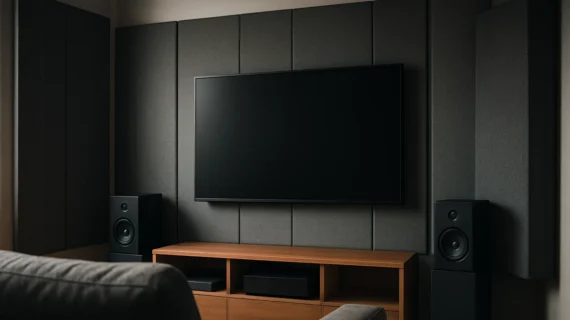
What “Minimal” Actually Means in Podcast Studio Design
In the context of a podcast studio, minimal means the fewest elements that still produce a clean recording, not an all-white aesthetic. Two separate problems need solving: soundproofing stops outside noise from entering the room, and acoustic treatment controls reverberation inside it. A room that looks clean but is missing either one will produce recordings that sound like a bathroom, regardless of how expensive the camera or microphone is.
The most common mistake is treating “minimal” as “just attach some fabric panels to the wall.” Fabric panels help control sound reflections inside the room, but they do nothing about noise coming from outside: HVAC hum, vehicles on the street, or a central air unit running above the ceiling. If the main problem is external noise, fabric panels on the walls will not change the recording result at all.
The correct framework is to work from outside in. Identify where the disruptive noise is coming from first, then decide which work is actually needed. If no external noise is entering, acoustic treatment inside the room is sufficient. If external noise is entering, soundproofing must be resolved before any interior treatment makes a meaningful difference.
This page covers decisions in that order. For a broader look at the full sequence of podcast studio interior design decisions, including furniture and lighting choices that support the workflow, there is a cross-reference available to read after this article.
How Much Space Does a Minimal Podcast Studio Actually Need?
The minimum room size for one podcaster is around 2×2 meters, provided the acoustic problems are handled correctly. That is not a vague “it depends”: 4 square meters gives enough space for one desk, one chair, absorber panels on the left and right walls, and bass traps in two rear corners.
Three scenarios come up most often in practice:
- An existing 2×2 meter room. This space can be treated acoustically, but low frequencies require care. Very small rooms tend to cause low-frequency buildup in the corners because the short distance between walls creates standing waves. The target reverberation time (RT60) for podcasting is 0.2 to 0.4 seconds. A room this small without adequate bass traps can produce an uneven RT60: high frequencies are already damped, but low frequencies are still ringing and make vocal tone sound boomy.
- A new partition built inside a larger room. This is often the more flexible option. Building an acoustic booth in the corner of a large office or living space gives control over dimensions, panel placement, and cable runs without altering the main structure of the building.
- A ready-made booth such as the one-person Silent Box. At 100x100x220 cm, this is the most compact option physically and requires no modification to the room it sits in. It is the relevant choice when the room cannot be changed structurally.
One principle to keep in mind: the smaller the room, the more precise the acoustic treatment needs to be. A smaller space is not automatically easier to treat. It is usually harder.
The Right Order of Work: What to Resolve Before Choosing Panels and Furniture
Creators who start with aesthetics, choosing wall colors and desk styles before examining acoustics, almost always redo the work. The correct sequence is outside in, structure before surfaces, function before appearance.
1. Identify external noise sources
Before buying a single sheet of acoustic material, sit in the intended studio room for 15 minutes with every device switched off. Note what you hear: traffic, HVAC, footsteps from the floor above, machinery from an adjacent room. These sounds determine whether the walls need soundproofing or whether acoustic treatment alone is enough. If no external noise enters, soundproofing work can be skipped.
2. Inspect walls, floor, and ceiling
Small gaps around pipes, poorly joined wall sections, or windows without acoustic seals are entry points for sound that are frequently overlooked. A core principle in building acoustics is that sound behaves like water: it enters through the smallest gap available. Sealing these gaps before adding any panels is inexpensive work that produces a disproportionate result.
3. Interior acoustic treatment
Once external sources are addressed and gaps are sealed, move to interior treatment. The panel positions with the greatest impact are at the first reflection points: the left and right walls level with the microphone, the wall behind the speaker, and the ceiling above the desk. Bass traps go in the room corners because that is where low-frequency energy accumulates most. Diffusers are needed only in rooms large enough that over-damping is a risk.
4. Aesthetics last
Color, lighting, and visual branding elements are finalized after acoustics are complete. Acoustic panels can be wrapped in fabric of any chosen color, and LED lighting can be positioned without sacrificing panel coverage. This sequence does not compromise appearance. It makes sure appearance does not compromise function.
To start this process correctly, a professional podcast studio build service with an on-site survey is the most efficient way to determine what work is genuinely required in the existing room before any budget is committed to materials.
When a Ready-Made Booth Makes More Sense Than Building a Room
A ready-made booth makes more sense when the room cannot be modified structurally, when the budget does not reach permanent construction, or when the setup may need to move locations. Permanent construction makes more sense when the space is fully owned, when more than one simultaneous microphone position is needed, or when the target isolation exceeds 50 dB. These two sets of conditions do not overlap. Determining which applies is a job for a site survey, not an assumption made from a photo.
For a more specific breakdown:
| Condition | Ready-made booth | Permanent construction |
|---|---|---|
| Leased space, no modifications permitted | Yes | No |
| Must relocate when office moves | Yes | No |
| Very limited production timeline | Yes (14 to 30 days) | Depends on scope |
| More than one microphone position needed | Limited | Yes |
| Target isolation above 50 dB | No | Yes |
| Space fully owned, long-term use | Optional | Yes |
The Silent Box ready-made podcast booth is available in a 100x100x220 cm one-person configuration, priced at Rp 35,000,000 excluding VAT. Its isolation performance is in the range of 35 to 50 dB depending on material and construction. That figure is worth noting carefully: it is not measured against ISO 23351-1, the standard used by some international brands. ISO 23351-1 measures speech level reduction, which is a different metric from wall reduction (Rw) or STC. Without referencing the same measurement standard, figures from different manufacturers cannot be compared directly.
Permanent room construction work is handled directly in the Jabodetabek area. Projects outside Jabodetabek are covered with mobilization costs stated openly in the proposal.
The Materials a Podcast Studio Actually Needs
This is not a product catalog. These are materials that perform functions no other material can substitute without a significant compromise to the result.
- Rockwool or Glasswool as the primary absorber inside panels. Both are fibrous materials that absorb sound energy and convert it to a negligible amount of heat. Rockwool is denser and more effective in the low-to-mid frequency range. Glasswool is lighter and often more cost-efficient. For a full comparison including density, recommended thickness, and the conditions where each performs best, read the Rockwool vs Glasswool comparison for sound dampening.
- Mass-loaded membrane or double-layer gypsum board for mass law. Where soundproofing is needed because external noise is entering, wall mass must increase. The mass law in acoustics states that the heavier and denser the wall, the greater its resistance to sound transmission. Lightweight fabric panels do not function here.
- Acoustic seals on door and window gaps. A gap as small as 1 cm under a door can undo most of the wall treatment work. Brush seals or neoprene gaskets fitted around the full perimeter of doors and windows close the main sound entry paths.
- Bass traps in room corners. Standard panels are not effective enough below 200 Hz. Bass traps use thick absorbers or purpose-built resonant construction to control the low-frequency energy that accumulates in corners.
Egg-crate foam and pyramid foam are not on this list for a straightforward reason: both absorb only high frequencies above 1 kHz and do nothing for soundproofing. Attaching them to walls does not reduce outside noise, does not control low frequencies, and does not replace any of the materials above.
The Non-Binding First Step: Survey and Estimate Before Deciding
A site survey is the most efficient way to answer the question that matters most: can the existing room be treated acoustically at a reasonable cost, or is a ready-made booth the better total value once construction cost, time, and the risk of a result that misses expectations are all counted?
For those not yet ready for a survey, the budget estimator on the Kontraktor Studio homepage is a non-binding starting point. Enter the room dimensions and basic requirements, and the estimator returns a cost range before any commitment is required.
For locations outside Jabodetabek: Silent Box is modular and assembled on-site, so delivery is available across Indonesia. No construction team needs to remain on-site during installation, unlike permanent construction projects.
For specific questions about an existing room, the starting point is a consultation through the professional podcast studio service page, where the room condition can be assessed before any costs are incurred.
FAQ: Minimal Podcast Studio Design
What is the minimum room size for a functional podcast studio?
A 2×2 meter room is enough for one podcaster, provided the acoustic problems are solved: reverberation controlled with absorber panels and bass traps in the corners, and external noise sources identified. Very small rooms can cause low frequencies to accumulate and become hard to control. If the room cannot be modified, a ready-made booth like the one-person Silent Box at 100x100x220 cm is the more compact physical alternative.
Are egg-crate foam or pyramid foam enough for a podcast studio?
No. Egg-crate and pyramid foam only absorb high frequencies and do nothing for soundproofing. Noise from outside the room, HVAC hum, or bass impact from adjacent rooms will not be reduced by foam on the walls. A clean-sounding podcast studio requires Rockwool or Glasswool absorbers for room treatment, plus gap sealing and added wall mass where external noise is entering.
How much does it cost to design and build a minimal podcast studio?
Cost depends on the existing room condition, size, target decibel reduction, and materials chosen. No universal per-square-meter figure applies without inspecting the building, ceiling height, and surrounding noise sources. The non-binding first step is to fill in the budget estimator on the Kontraktor Studio homepage, followed by an on-site survey for Jabodetabek or a remote consultation for other locations.
What is the difference between acoustic treatment and soundproofing for a podcast studio?
Soundproofing stops sound from crossing the room boundary, for example traffic noise or sound from a neighboring room. Acoustic treatment controls reverberation and reflections inside the room itself. A good podcast studio needs both, but the proportion depends on how noisy the surrounding environment is. The two are frequently confused, and mixing them up is the most common reason podcast studio renovations produce disappointing results.
Can a podcast booth like Silent Box be shipped outside Jakarta?
Yes. Silent Box is modular and assembled on-site, so it can be shipped anywhere in Indonesia. Permanent room construction is limited to Jabodetabek and other major cities with mobilization costs stated openly in the proposal. For locations outside Jabodetabek, the ready-made booth is often the more practical choice because it does not require a construction team to stay on-site.